
Three years ago, a home office in Bangladesh meant a laptop on the dining table. Today, it means a dedicated workspace that thousands of professionals use 8-12 hours a day, 5-6 days a week — to run businesses, write code, join international video calls, manage teams, and build careers.
The shift happened fast. Bangladesh's IT and outsourcing sector, which employs over 300,000 people, saw a massive move toward remote and hybrid work during and after the pandemic. Freelancers on Upwork, Fiverr, and Toptal — Bangladesh is one of the top freelancing nations globally — have always worked from home. Startup founders in Dhaka increasingly operate from home offices to keep overhead low during early growth. Corporate employees at multinationals and local tech companies now split their weeks between home and office.
But here is the problem: most Bangladeshi homes were never designed for work. A 1,200 sqft apartment in Uttara or a 900 sqft flat in Mirpur does not have a spare room waiting to become an office. The living room is for the family. The bedroom is for sleeping. The dining table is for eating. Finding space, quiet, and functionality for serious professional work inside a Bangladeshi home requires thoughtful home office interior design — not just buying a desk and chair.
This guide covers how to create a productive, comfortable, and professional home office in Bangladesh — whether you have a dedicated room or just a corner of your bedroom.
The Reality of Working From Home in Bangladesh
Before we talk about design, we need to acknowledge the unique challenges that make home office design in Bangladesh different from what you see in Western design magazines and YouTube videos:
Space is limited. The average Dhaka apartment is 800-1,400 sqft for a 2-3 bedroom family. There is no spare room. Your home office will likely be carved out of a bedroom, living room corner, dining area, or balcony. Every design decision must account for shared space.
Power interruptions are real. Load shedding in Bangladesh, while improving, still affects work schedules. A home office needs to account for UPS or IPS backup for the router, laptop, and monitor — and ideally a power-efficient setup that runs longer on backup.
Dhaka is loud. Car horns, construction noise, street vendors, neighbors, and family activity — sound management is not optional for anyone who takes video calls. A home office without acoustic consideration is a video call disaster waiting to happen.
The climate is hot and humid. Working in a room without proper cooling means sweating through every Zoom call. But running AC in one room of a Dhaka apartment all day increases electricity bills significantly. The home office needs to be cooling-efficient.
Family boundaries are complex. In Bangladeshi households, privacy is cultural — children, parents, spouses, and sometimes extended family members share space constantly. A home office must create a psychological and physical boundary that says "I am working" without building a wall through the family home.
These are not excuses — they are design parameters. A well-designed home office works within these constraints, not despite them.
Option 1 — Dedicated Home Office Room
If you have a spare room — even a small one (80-120 sqft is enough) — converting it into a dedicated home office is the best possible setup.
Desk Placement. Position your desk facing away from the door if possible — this reduces distraction from people walking past and gives you a clean wall or window as your visual backdrop during video calls. If the room has a window, place the desk perpendicular to the window — natural light from the side is ideal. Avoid sitting with the window directly behind you (creates a silhouette on video calls) or directly facing the window (screen glare and eye strain).
Furniture Essentials. A desk at least 120cm wide — you need space for a laptop, an external monitor (strongly recommended for anyone working 6+ hours daily), a notebook, and a water bottle without feeling cramped. A proper office chair with lumbar support, adjustable height, and armrests. This is the single most important investment in your home office. A ৳15,000-30,000 ergonomic chair will save you from back pain, neck strain, and posture problems that a dining chair or plastic chair will cause within months. A bookshelf or wall-mounted shelving for files, books, and supplies. Keep the desk surface clean — everything that is not used daily goes on the shelf.
Video Call Setup. For professionals who take regular video calls — clients, international meetings, team standups — your background matters. A clean, organized wall behind you communicates professionalism. Options include a simple painted wall in a neutral color with one or two framed items, a small bookshelf behind you with neatly arranged books, or a fabric or wooden panel mounted on the wall as a clean backdrop. Avoid showing your bed, laundry, or family photos as your video call background — it is unprofessional for client-facing calls.
Lighting for the Room. Overhead LED panel light (4000K neutral white) for general room illumination. A desk lamp for task lighting — positioned on the side opposite your writing hand to avoid shadows. For video calls, a ring light or desk-mounted LED panel facing you eliminates shadows on your face and makes you look professional on camera. Avoid relying solely on the overhead light for video calls — it creates harsh shadows under your eyes.
Door and Sound. If the room has a door, it is already better than any open-plan setup. Replace a hollow-core door with a solid-core door for better sound isolation. Add a simple door sweep at the bottom to block sound leaking through the gap. During important calls, a "do not disturb" sign or light indicator outside the door communicates to family members that you are in a meeting.
Option 2 — Bedroom Office Corner
This is the most common setup in Bangladesh — a work area within the bedroom because there is no spare room.
Defining the Zone. The biggest challenge is psychological — your brain needs to separate "sleep space" from "work space" within the same room. Design techniques that help include placing the desk in the corner furthest from the bed so your back faces the bed while working, using a small bookshelf, room divider, or tall plant as a visual separator between the work zone and sleep zone, using different lighting for each zone — cool white task light at the desk, warm ambient light near the bed. When you switch lights, your brain registers the shift, and keeping the desk completely clear at the end of the work day so the room reverts to a bedroom visually.
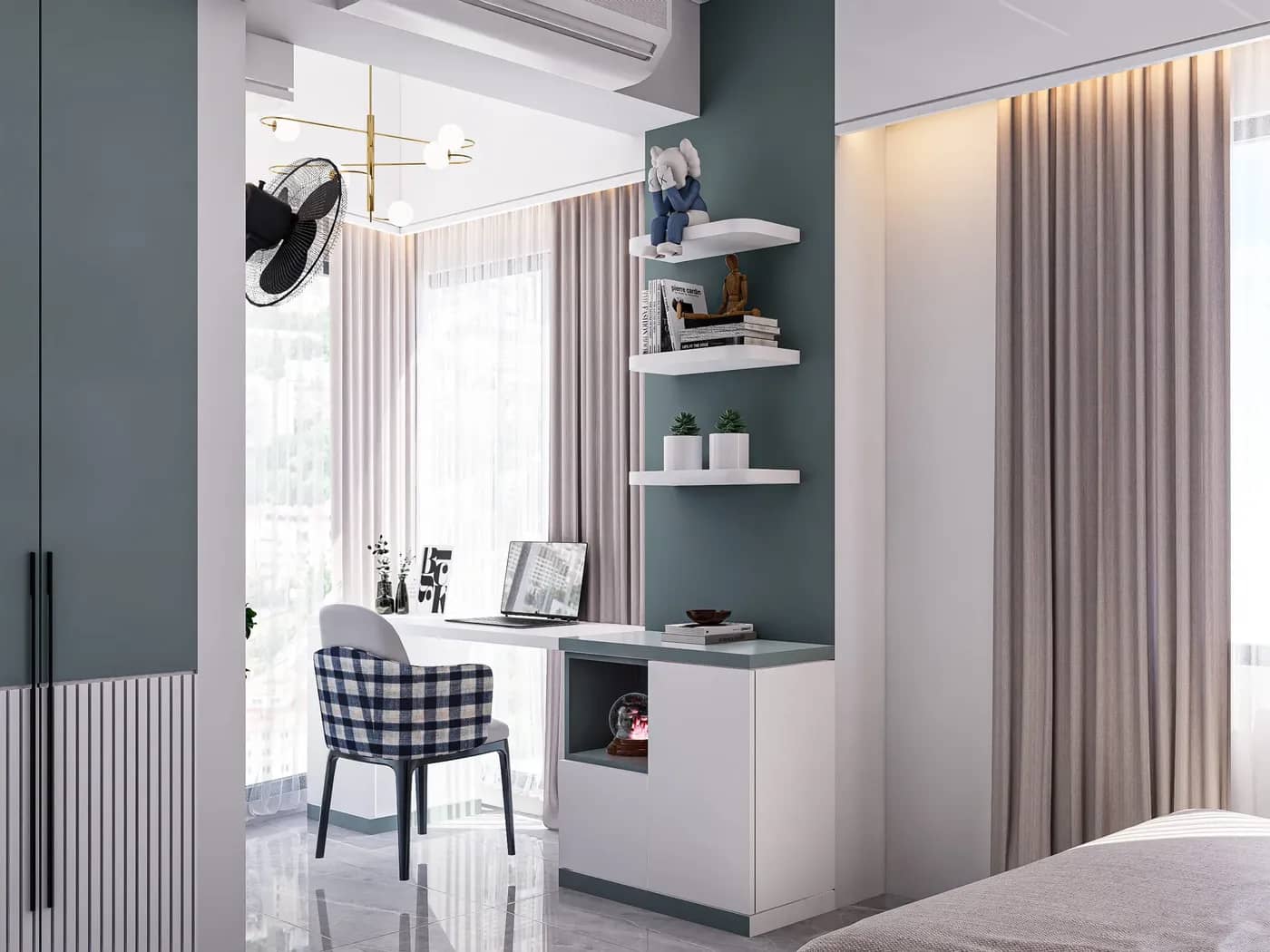
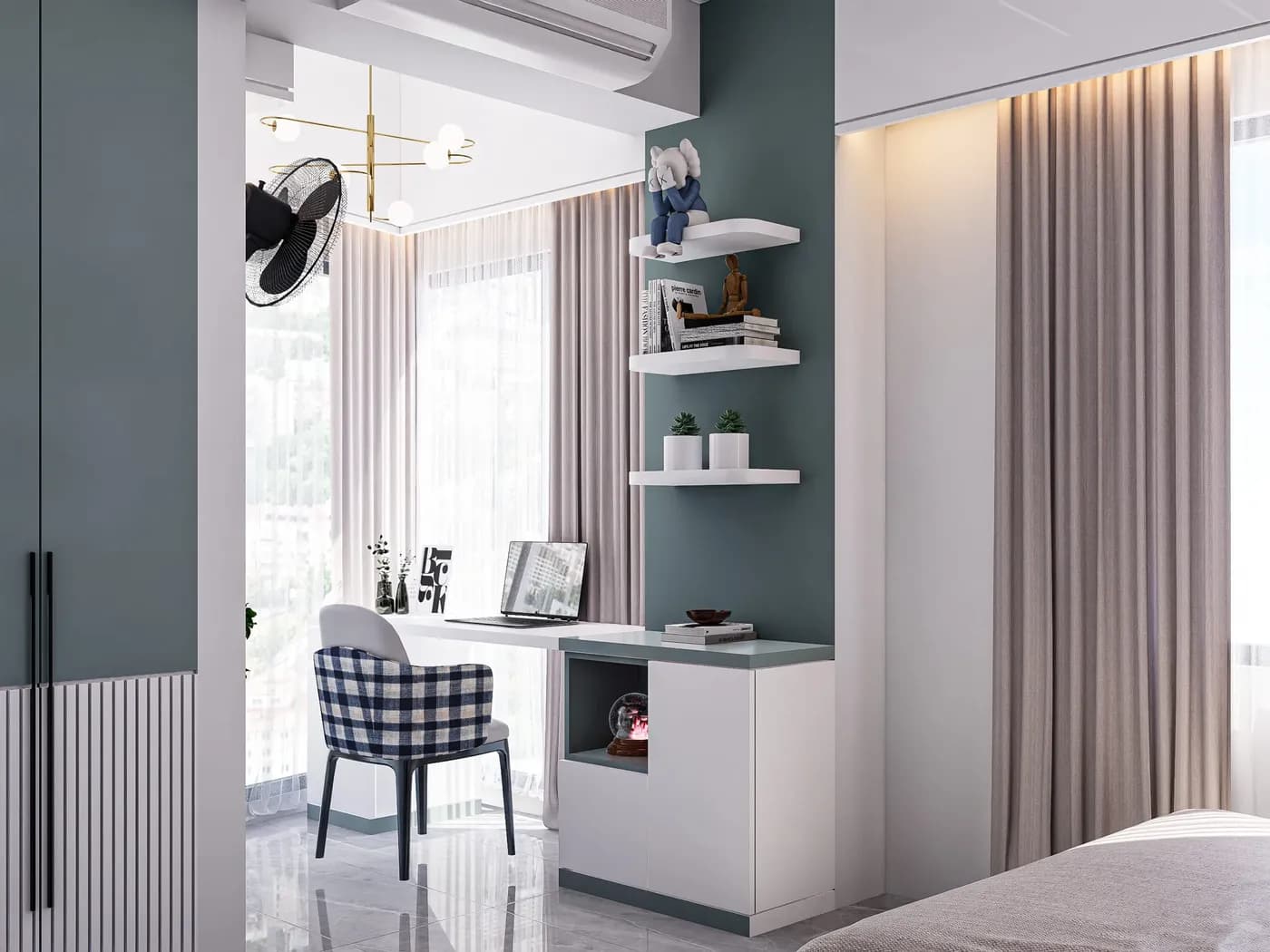
Desk Options for Small Bedrooms. A wall-mounted fold-down desk — folds flat against the wall when not in use, freeing floor space for the bedroom. A compact L-shaped corner desk — uses the corner efficiently and provides more surface area than a straight desk in the same footprint. A floating shelf desk — a deep wall-mounted shelf (45-60cm deep) at desk height, with no legs taking floor space. This works well in very tight spaces.
Wardrobes as Office Walls. A clever trick for Bangladeshi bedrooms — position the wardrobe to partially screen the desk area from the bed. The wardrobe becomes a room divider while serving its primary storage function. The desk sits in the pocket of space behind or beside the wardrobe.
Option 3 — Living Room or Dining Area Workspace
If neither a spare room nor the bedroom works, the living room or dining area becomes your office.
Behind the Sofa. A narrow console table (35-45cm deep) placed behind the sofa, against the wall, creates a workspace that is invisible from the main living room seating area. You sit facing the wall with the sofa back behind you. When not working, the console table looks like a normal piece of living room furniture.
Dining Table as Desk. If you work from the dining table, invest in a portable desk organizer — a tray or box that holds your laptop stand, mouse, charger, notebook, and pens. At the start of the work day, place the organizer on the table. At the end, pack everything into the organizer and put it away. The dining table returns to family use. This discipline is essential — if work items permanently occupy the dining table, family resentment builds quickly.
Built-in Niche. Some Dhaka apartments have small niches, alcoves, or unused corners near the entrance or in the corridor. A built-in desk fitted precisely into this space — with shelving above and a small cabinet below — creates a compact office that occupies zero usable room area. These custom solutions are surprisingly affordable and incredibly space-efficient.
Option 4 — Balcony Conversion
Many Dhaka apartments have a balcony that is underutilized — used for drying clothes or storing random items. With proper treatment, a balcony can become an excellent home office.
What you need to do. Enclose the balcony with glass sliding doors or windows — this is essential for AC efficiency and sound isolation. Waterproof the floor and walls — balconies in Bangladesh are exposed to monsoon rain and humidity. Install a split AC unit — balconies get extremely hot in Dhaka's summer without cooling. Add proper electrical points — at least 3-4 power outlets for laptop, monitor, router, and charging. Ensure internet connectivity — run an ethernet cable or position a Wi-Fi extender for strong signal.
Why it works. A converted balcony gives you a physically separated workspace with a door you can close. The natural light from the glass enclosure is excellent for both work and video calls. And you are not taking away any existing room from the family — you are creating new usable space from an area that was previously wasted.
Caution. Balcony conversion needs to be done properly. In Bangladesh's climate, improper waterproofing leads to leaks during monsoon. Poor glass installation leads to heat buildup. And some building management committees restrict balcony enclosure — check before starting work.
The Bangladesh-Specific Home Office Checklist
Here are the non-negotiable elements for any home office in Bangladesh, regardless of which option you choose:
Internet Backup. Your primary broadband connection will occasionally go down. Have a mobile data backup — a second SIM with a data package on your phone, ready to hotspot. For professionals whose income depends on connectivity (freelancers, remote workers for international companies), consider a portable 4G router as a dedicated backup.
Power Backup. A UPS (Uninterruptible Power Supply) is essential — it keeps your router and laptop running during the 5-10 seconds it takes for the IPS or generator to kick in. Without a UPS, every power cut disconnects your video call and drops your internet. A 600VA-1000VA UPS costs ৳3,000-6,000 and is the best investment you can make for uninterrupted work.
Cooling Strategy. If your home office is a small room or corner, a portable AC unit or a dedicated split AC on a timer can be more energy-efficient than cooling a larger room all day. Position the AC so it does not blow directly on you — cold air on one side of your body while the other side is warm creates discomfort and health issues over time.
Cable Management. Laptop charger, phone charger, monitor cable, mouse, keyboard, ring light, router — home offices generate cable clutter fast. Use a cable management box on the floor to hide the power strip and excess cables. Use adhesive cable clips under the desk edge to route cables invisibly. A clean desk with hidden cables looks professional on video calls and reduces daily frustration.
Background Noise Solutions. For video calls, use a headset with a noise-cancelling microphone — this is far more effective than trying to soundproof the room. ANC (Active Noise Cancellation) headphones in the ৳5,000-15,000 range block most ambient noise from reaching the microphone. For sound entering the room, heavy curtains on windows, a door sweep on the bottom of the door, and soft furnishings (rugs, fabric chair) absorb echo and reduce ambient noise.
Ergonomic Setup. The top of your monitor should be at eye level — use a monitor stand or laptop riser. Your elbows should be at 90 degrees when typing. Your feet should be flat on the floor or on a footrest. Your chair should support your lower back curve. These are not luxury preferences — they are basic requirements for anyone working 6+ hours daily. Ignoring ergonomics leads to back pain, neck strain, carpal tunnel, and eye strain within months.
Common Home Office Mistakes in Bangladesh
Working on the bed or sofa. It feels comfortable for 30 minutes. After 3 months, you have back pain, poor posture, and your brain cannot distinguish between rest space and work space. Your sleep quality drops because your brain now associates the bed with work stress. Use a proper desk and chair — always.
Ignoring the video call background. Your background during a client call or team meeting communicates your professionalism. An unmade bed, a pile of laundry, or a cluttered shelf behind you undermines everything you say in the meeting. Invest 30 minutes in creating a clean, professional backdrop.
No boundaries with family. In Bangladeshi households, the concept of "I am working, please do not disturb" is culturally unfamiliar. A physical signal helps — a closed door, headphones on, or a small desk sign that says "In a meeting." Have a direct conversation with family members about your work hours and when interruptions are okay versus when they are not.
Skipping the chair. Of all home office expenses, the chair is the one to not compromise on. A ৳2,000 plastic chair used 8 hours daily will cause physical pain within weeks. A ৳15,000-25,000 ergonomic chair used 8 hours daily will keep you comfortable and healthy for years. The math is simple — your health is not worth saving ৳13,000 on.
Not managing cables. Tangled cables on the desk and floor create visual chaos that subtly increases stress and reduces focus. Spend ৳1,000 on a cable management box and desk clips. The difference in how your workspace feels is remarkable.
Home Office Design for Specific Professions
Software Developers and IT Professionals. Dual monitor setup is almost essential — code on one screen, browser/testing on the other. Mechanical keyboard for extended typing comfort. Good quality headphones for focus during coding sessions. A whiteboard or large notepad on the wall for architecture diagrams and planning. Ethernet connection (not just Wi-Fi) for stable, low-latency connectivity. Sit-stand desk converter for alternating between sitting and standing during long coding sessions.
Freelance Designers and Creatives. Color-accurate monitor (IPS panel) for design work. Graphics tablet (Wacom or equivalent) with adequate desk space for tablet placement. Calibrated lighting — design work requires consistent, neutral lighting to judge colors accurately. External hard drive for project backup — client work loss is career-ending.
Online Teachers and Content Creators. Quality microphone — a ৳3,000-8,000 USB condenser microphone dramatically improves audio quality over laptop mics. Ring light or panel light for even facial illumination. Clean, professional background — consider a simple backdrop panel if your room is cluttered. Stable camera position — a webcam mounted on a tripod or monitor-top clip.
Business Owners and Managers. Professional backdrop for client video calls. A small meeting area if you occasionally host visitors at home — even a 2-person sitting arrangement near the desk. Filing cabinet or lockable storage for business documents. Printer and scanner — still essential for contracts, invoices, and government paperwork in Bangladesh.
When to Call a Professional
A basic home office setup — desk, chair, lamp, cable management — can be done yourself. But if you are planning a dedicated room conversion, a balcony enclosure, a built-in desk and shelving system, or integrating the home office into a larger apartment interior design project, professional help saves time and money.
Interior Villa designs home offices as part of our apartment and home interior design projects across Dhaka. Whether it is a compact study corner in a 2-bedroom flat in Mirpur or a dedicated office suite in a Gulshan duplex, we design workspaces that fit your home, your work style, and your family life — without compromising either.